Last Updated on January 26, 2026 by Don Gerig, RDCS
CardiServ is committed to supporting individuals and organizations that share our values of inspiring excellence in echocardiography. I recently had the opportunity to interview Michael Owen, RDCS, RVT, a sonographer and the developer of EchoWorkflows.com. I also had the chance to put his tool to the test in a real-world clinical environment in a busy echo lab.
What stood out immediately was how naturally the tool fit into daily workflow, providing clear, guideline-driven direction without slowing the pace of patient care.
In this guest post, Michael shares the story behind the tool, the clinical challenges that led to its development and how it’s already being used by hundreds of sonographers and physicians around the world to simplify reporting and support consistent application of ASE guidelines in practice.
Related: Evaluating Diastolic Function – Understanding the Basics
What Is EchoWorkflows.com?
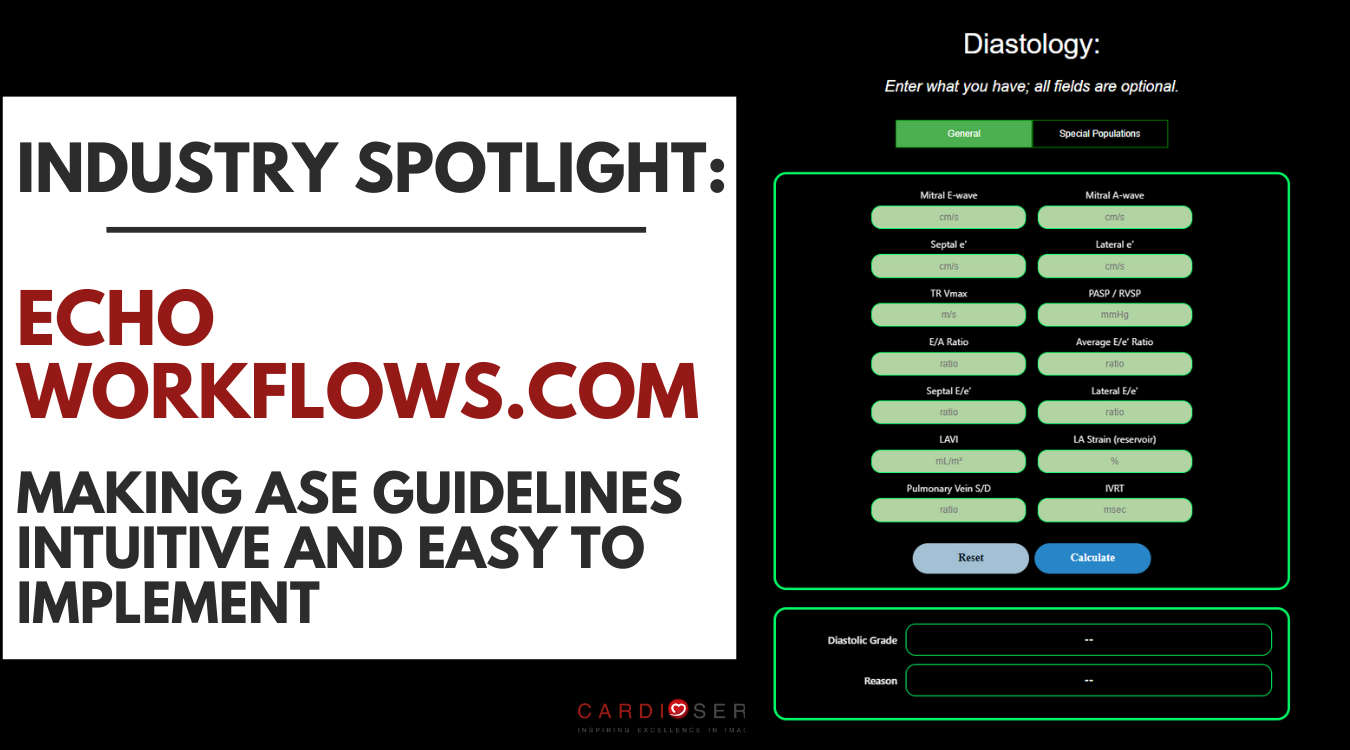
EchoWorkflows.com is a completely free web-app designed to make ASE guidelines intuitive and easy to implement within a clinical environment. Spanning from the newly updated diastology algorithms (ASE 2025 diastology update) and right heart values (ASE 2025 Right Heart update) to the expected gradients and EOAs for every size and type of prosthetic valve, this tool has something for everyone. Even dense calculations such as EROA, Regurgitant Fraction, Regurgitant Volume, PPM, PVR and more have been reduced from minutes to mere seconds.
Built by a Cardiac Sonographer
From start to finish, the design, layout, fine-tuning of flow and even the programming itself was all performed by a practicing echocardiographer who continues to scan and report, even today. This develop-by-experience approach has resulted in a beautiful mesh of design and practicality that truly enhances the sonographer experience and improves efficiency in a way we’ve never seen before. Better yet, there are no sign-in requirements, no ads and no collection of personal information, not even a download. All barriers have been removed other than an internet connection.
The Problem With Outdated Algorithms on the Wall
“You can go to almost any sonography lab and find algorithms posted all over the walls and unfortunately, this creates an environment where patients are evaluated incompletely or incorrectly.”
You can walk into almost any sonography lab and find guideline algorithms posted throughout the reading rooms. While well intentioned, this often creates an environment where patients are evaluated incompletely or inconsistently.
Why the Old Algorithms Fall Short
Based on my own experience in the Austin area, many labs still rely on the two primary 2016 diastology algorithms, which are frequently displayed but not always clearly interpreted. Terms such as myocardial disease can be ambiguous and may be applied differently depending on whether left ventricular hypertrophy, ischemia, inflammation, or other pathology is present.
Even worse, they exclude all of the caveats surrounding special population patients such as those who present with A-fib, MS, HCM, or severe AI, among other pathologies. There are ways of evaluating filling pressures in these patients but they do not follow the same flow as the two primary algorithms. This either leads to an incorrect assessment of diastolic function (as the incorrect algorithms are being applied) or a conclusion of indeterminate diastology when in fact, there are ways of evaluating these types of patients.
What Changed With the 2025 ASE Diastology Update
Fast forward to 2025, as the diastology guidelines have been updated once more, there is an additional degree of separation that leaves reporting processes scattered amongst institutions. Discrepancies can be found even within the same institution. My goal was to simply the new algorithms, including the caveats, and standardize the reporting process in a way that ensures access to the newest information without sacrificing time which is precious in a fast-paced clinical environment.
How EchoWorkflows Guides Clinical Decision Making
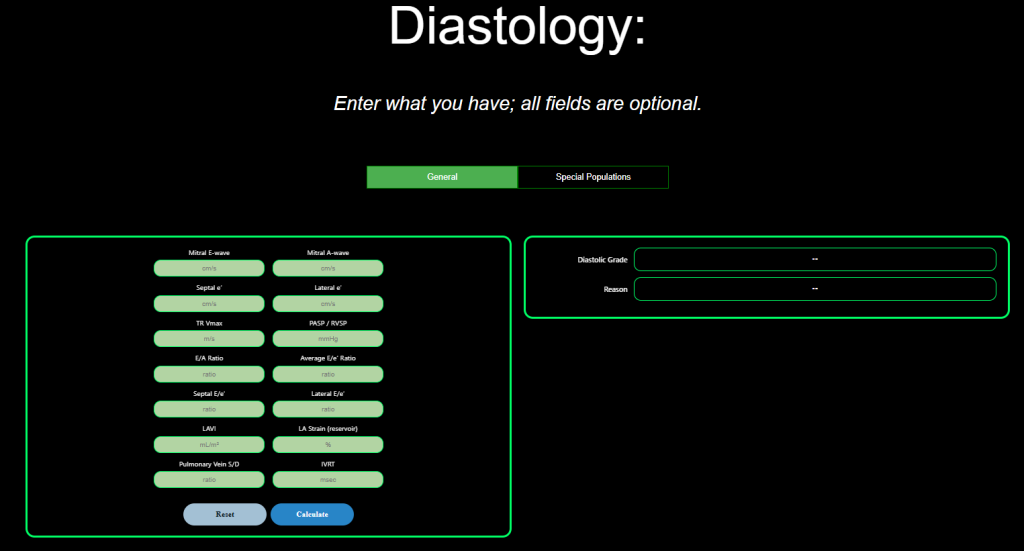
The algorithms are baked into a calculator-like interface allowing technicians, physicians and students to merely type in values from their study. The tool then steers the users in the right direction based on the values they input and prioritizes the heavily weighted values while simultaneously encouraging the input of secondary supportive values.
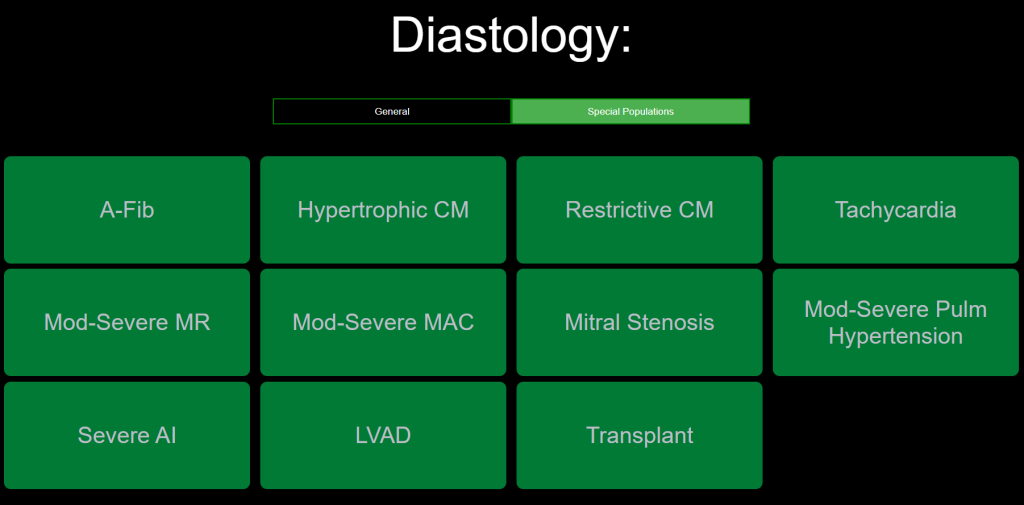
In practice, even when looking at the algorithms directly, this can still be quite complicated so removing the guesswork is welcomed. In fact, you can hit “calculate” on the calculator with no values input and the “calculator” will instruct you on how to start.
Cool right? If this concept seems challenging to envision, there is a nice demonstrative video under the hamburger menu on EchoWorkflows.com. I highly recommend giving it a watch to fully understand the mechanics of the tool.
Beyond Diastolic Function
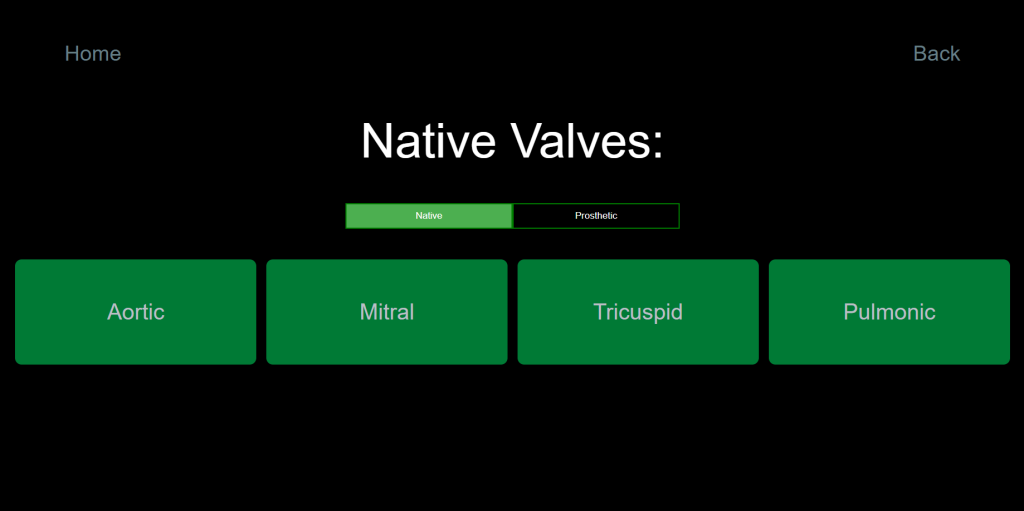
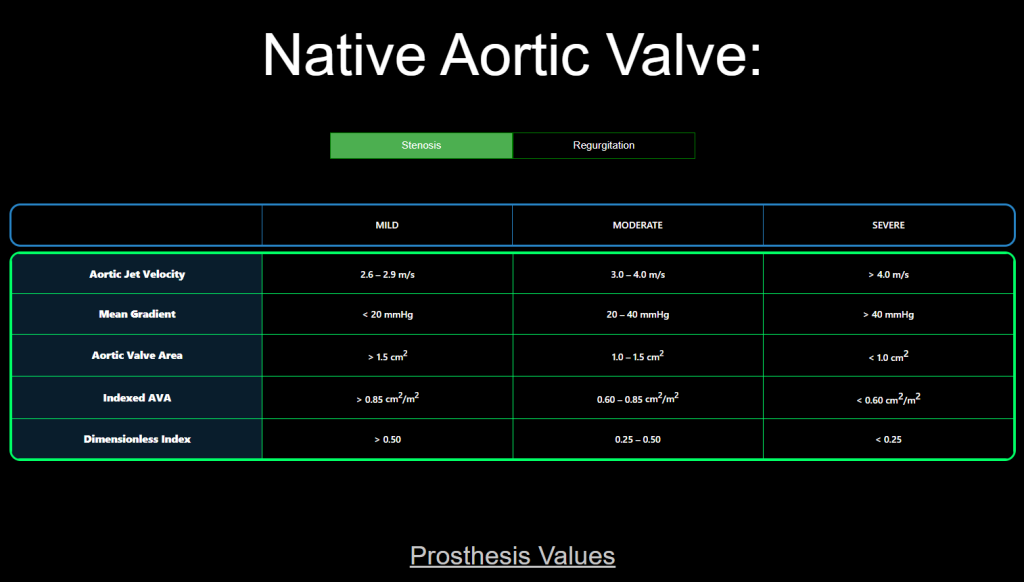
Moving beyond diastology, EchoWorkflows.com also includes other relevant ASE information such as stenosis and regurgitation values for every valve (both native and prosthetic).
The speed of acquisition is still likely the fastest out of any tool available today. It’s as simple as clicking “valves,” “aortic,” and “stenosis.” Three clicks and your presented with all of the mild, moderate and severe ranges without the extra fluff.
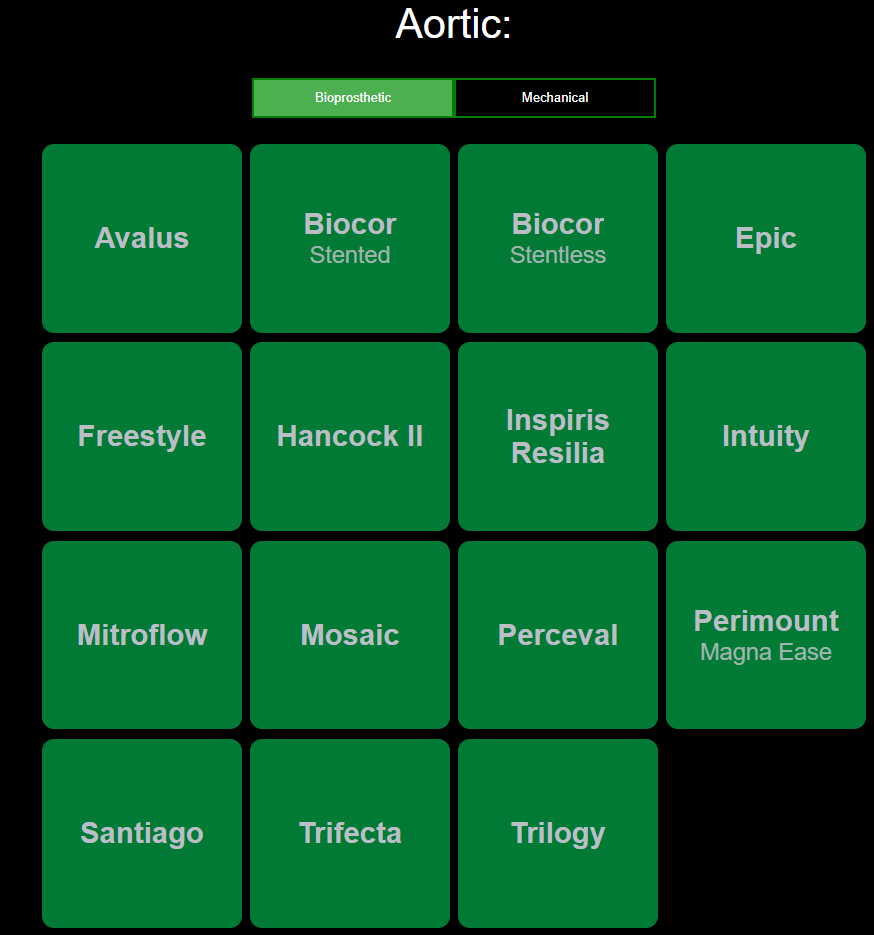
Thanks to feedback from a local Austin cardiologist, the most recent update also includes the expected gradients and EOA’s for every type of prosthetic valve.
Whether it’s a 26mm or 32mm natively implanted percutaneous valve, a valve-in-valve implant or a surgically implanted bioprosthetic or mechanical valve, the ranges, typically presented in standard deviation format, have all been displayed with simplified ranges and a visually pleasant manner.
A Community Driven and Continuously Improving Tool
This leads me to describe the long-term vision behind the project. EchoWorkflows.com is meant to be a community driven tool. Similar to the physician feedback above, I’ve continuously been encouraged (and received) feedback from professors, technicians, physicians and students.
If a mistake is found, an update to a value is necessary or even if there is a desire for a new feature, his contact information is easily obtainable straight from the site. So far, thanks to a professor, the right heart values have been recently updated with 2025 guidelines and thanks to a technician, the e’ values allow for more decimal places and are no longer rounded before E/e’ is calculated.
This leads to greater precision and accuracy over time. Anybody who finds value is encouraged to provide feedback. As a disclaimer, when it comes to potential feature requests, there may be some limitations due to my own limited knowledge in programming. I’m a cardiac sonographer first and foremost after all.
Built In Calculators That Save Time
Back to the benefits of the tool. Navigating male versus female values is also a breeze. With a single click, you can flip between left heart chamber sizes for each sex in seconds. However, the biggest time saver, when it comes to workflow, likely comes from the built in calculators.
These calculators, also beautifully designed and intuitively laid out, reduce minutes into seconds and saves you from having to scribbling down equations halfway down a sheet of paper by hand. Whether it’s EROA, Regurgitant Volume, Regurgitant Fraction, Qp:Qs, LA index, PPM or PVR, it’s as simple as typing in numbers from your exam. The MR EROA calculator actually spits out three values at once saving you three separate calculations!
Once more, all of this is better demonstrated visually so please consider visiting EchoWorkflows.com and select the demonstrative video for a comprehensive review of the available features.
Real World Adoption in Busy Echo Labs
Currently, there are approximately 850 active users spanning the United States and other countries which is a solid testament to how important and necessary a tool like this is.
Previously, applications (that require download and personal information) that attempted similar things were relatively clunky, text heavy and challenging to navigate in a pinch.
Realistically, sonographers are plagued with stat exams, timed procedures, outpatient back to back outpatients so what we need is something suitable for this type of environment. Until AI completely takes over the reporting process, this is the best possible solution to date and with your help, it will continually improve over time.
EchoWorkflows Demonstration
Final Thoughts
At CardioServ, we enjoy supporting innovations that inspire excellence, improve workflow and elevate clinical practice in echo. EchoWorkflows.com reflects hundreds of hours of development by a sonographer who continues to invest time and expertise into the cardiology community.
For those who find value in the tool, support can take many forms, including sharing it with colleagues, students, educators, and physicians who may benefit from its use. Optional donations help sustain ongoing development and future updates, ensuring the tool remains free, current, and accessible.
While EchoWorkflows.com works across all devices, it’s best experienced on a desktop, and some institutions may require IT approval to whitelist the site for clinical use.