Last Updated on May 11, 2026 by Don Gerig, RDCS
Reliable echo AI validation depends on clinically accurate measurements, standardized workflows, and high-quality imaging data.
Echo AI and echocardiography AI technologies are rapidly reshaping cardiovascular imaging. While much of the industry conversation focuses on automation, workflow efficiency, and algorithm performance, far less attention is given to one of the most important factors behind reliable AI development: measurement validation and clinical data integrity.
The accuracy of any cardiovascular imaging AI model ultimately depends on the quality, consistency, and clinical reliability of the data used to train and validate it.
At CardioServ, our team has had the opportunity to support ongoing work with iCardio.ai through clinical measurement review, validation workflows, and echocardiography quality processes that contribute to the refinement of AI-driven imaging solutions.
As echo AI adoption accelerates across cardiovascular imaging, one reality is becoming increasingly clear:
AI models are only as strong as the data foundation behind them.
Echocardiography AI Faces a Unique Challenge
Unlike many imaging modalities, echocardiography is highly operator dependent.
Image acquisition varies based on:
- sonographer technique
- patient body habitus
- Doppler alignment
- foreshortening
- timing selection
- tracing methodology
- off-axis imaging
- equipment differences
- image optimization settings
Even among experienced clinicians, variability can exist in how structures are measured, contours are traced, or hemodynamic calculations are derived.
This creates one of the biggest challenges in echocardiography AI development: defining reliable ground truth.
If training datasets contain inconsistent measurements or variable interpretation standards, echo AI systems may inadvertently learn inconsistency instead of accuracy.
Why Echo AI Validation Matters
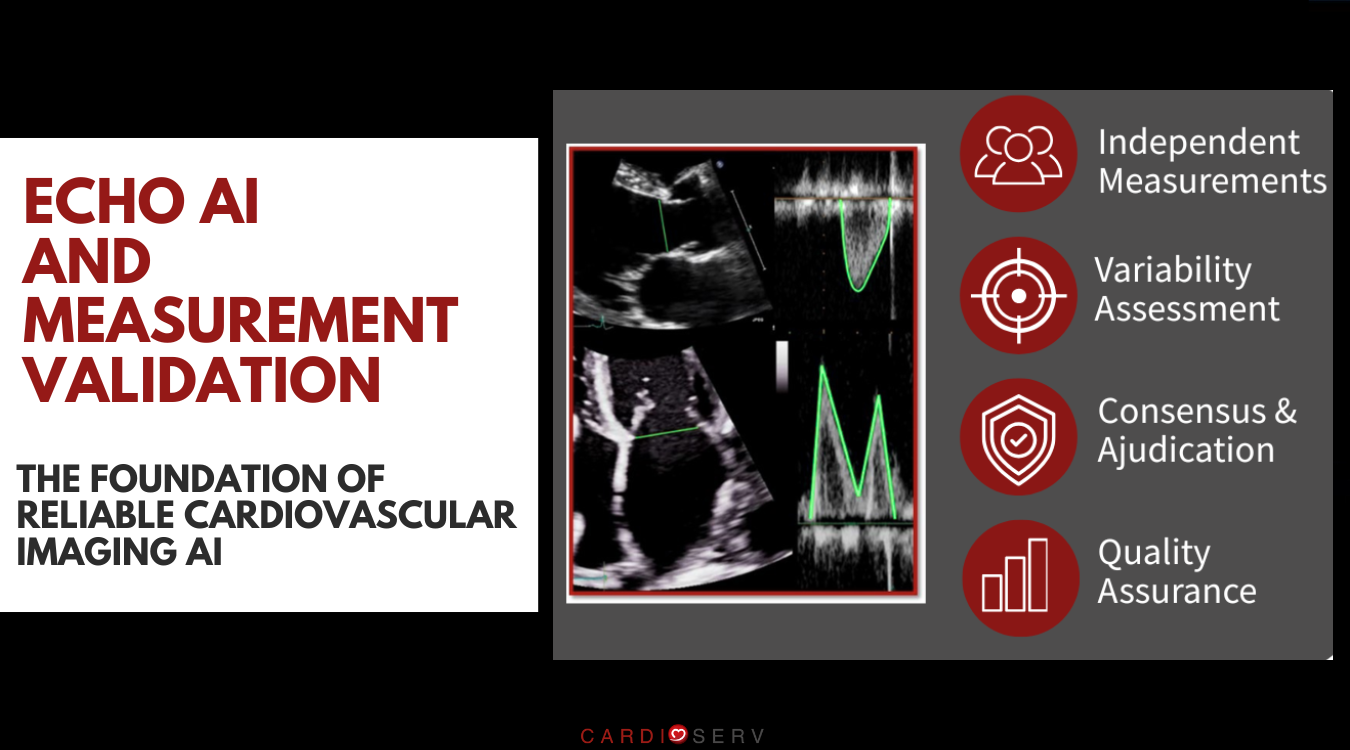
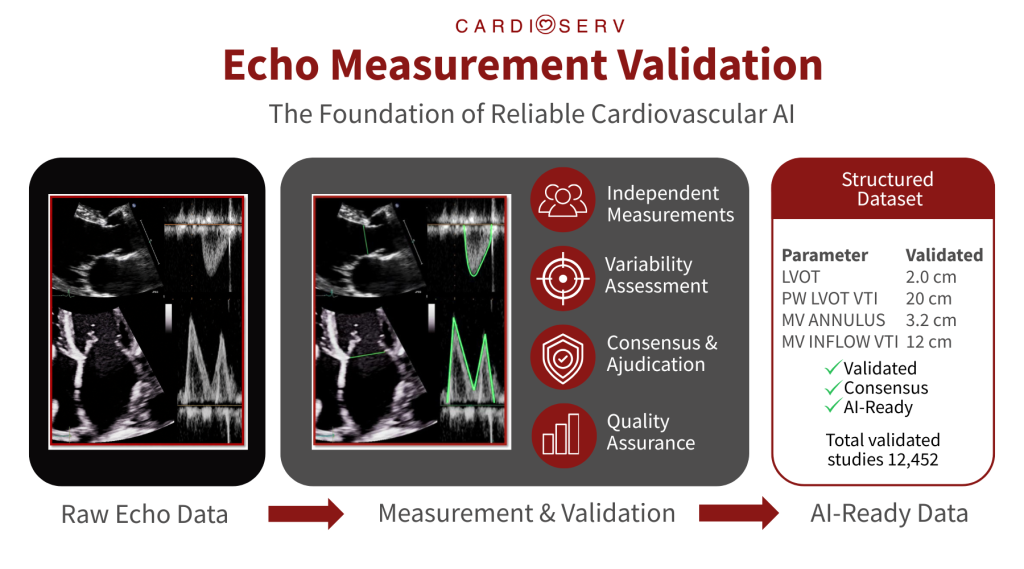
One of the least visible but most important aspects of cardiovascular imaging AI development is the process of validating and calibrating imaging data at scale.
This work often includes:
- expert measurement review
- independent measurements
- variability assessment
- consensus adjudication
- quality assurance workflows
- structured validation methodologies
At CardioServ, these quality processes have long been central to our work through accreditation consulting, peer review systems, variability reduction initiatives, and ongoing quality improvement programs within echocardiography labs.
Those same principles become increasingly important as echocardiography AI systems continue to evolve.
Because before AI can automate a measurement, someone first has to determine:
- what the correct measurement actually is
- whether image quality supports accurate analysis
- whether tracing methodology is appropriate
- whether measurements are reproducible across readers and clinical environments
Reliable cardiovascular AI requires clinically validated data.
Echo AI Requires More Than Large Datasets
Recent industry developments involving expanded access to multimodal cardiovascular imaging datasets highlight where cardiovascular AI is heading next.
The future likely extends beyond isolated image interpretation toward systems capable of integrating:
- echocardiography
- ECG
- cardiac CT
- cardiac MR
- longitudinal outcomes
- procedural data
- hemodynamic information
This creates the potential for cardiovascular imaging AI systems that not only identify structures, but also contextualize disease progression, support clinical decision-making, and improve predictive modeling.
However, scaling this type of intelligence requires far more than large datasets alone.
It requires curated datasets supported by:
- validated measurements
- standardized workflows
- reduced variability
- clinically reliable reference standards
That is where echo AI validation becomes indispensable.
AI Will Increase the Importance of Clinical Quality Infrastructure
One misconception surrounding AI is that automation replaces expertise.
In reality, the opposite may prove true.
As echo AI becomes more integrated into cardiovascular imaging, the importance of:
- standardized acquisition
- quality assurance
- expert oversight
- variability reduction
- clinical validation
may increase substantially.
AI systems still require:
- trustworthy training data
- ongoing calibration
- clinical verification
- real-world performance monitoring
The future likely belongs not to AI alone, but to systems where clinical expertise and artificial intelligence work together.
These same themes were explored further in our previous article, Echo AI Validation in Action, which discusses the importance of real-world validation, measurement consistency, and variability reduction in echocardiography AI workflows.
The Opportunity Ahead
Cardiology is entering a period where imaging data, artificial intelligence, and longitudinal clinical outcomes are beginning to converge at scale.
This may represent one of the most important transitions in cardiovascular diagnostics in decades.
We are proud that the work our team performs in echocardiography quality, measurement validation, and clinical consistency contributes to this broader evolution in cardiovascular imaging.
Because behind every successful echo AI system is a foundation of human expertise, quality control, and clinically validated data.
To learn more about CardioServ’s work in echocardiography quality improvement, variability reduction, and cardiovascular imaging workflows, explore our quality initiatives and eCardioServ platform.

Judith Buckland, President
Connect on LinkedIn