Last Updated on April 22, 2026 by Don Gerig, RDCS
Chagas disease is no longer something you only read about in global health textbooks. It is already here.
An estimated 300,000 people in the United States are living with Chagas disease, and 8 million worldwide, most of them undiagnosed. For many patients, the first signs of infection emerge only after cardiac involvement, often detected through abnormalities on ECG and echocardiography.
It’s not just about identifying dysfunction. It’s about recognizing patterns that don’t fit typical ischemia or dilated cardiomyopathy findings.
In 2018, the American Society of Echocardiography and the American Heart Association published key guidance on the evaluation and management of Chagas cardiomyopathy. In this article, we’ll review the disease process and focus on how echocardiography helps identify cardiac involvement and guide clinical suspicion.
What Is Chagas Disease (ChD)?
Chagas disease is caused by the protozoan parasite Trypanosoma cruzi. It is most commonly transmitted through contact with the feces of triatomine insects, often referred to as “kissing bugs.” While traditionally associated with Latin America, migration patterns have made the disease increasingly relevant in the United States, particularly in states like Texas.
However, contact with the insect is not the only way the disease is transmitted. It can also spread through blood transfusion, organ transplantation, congenital transmission, and contaminated food sources.
Without treatment, approximately one-third of infected individuals will go on to develop clinically significant cardiac disease.
How Chagas Disease Leads to Cardiomyopathy
Understanding how Chagas progresses is key, because the echo findings we see later are a direct result of this timeline.
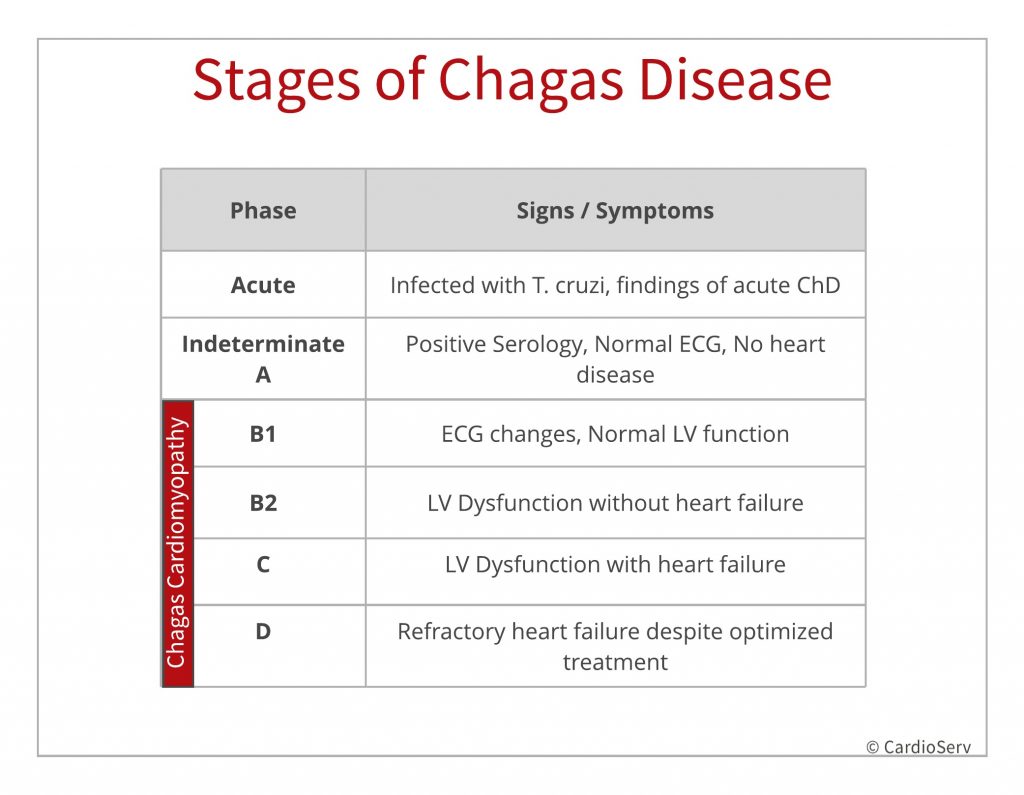
Acute Phase
The acute phase is often mild or asymptomatic and may go unrecognized.
- Occurs weeks after infection
- Parasitemia is present
- Symptoms are typically nonspecific (fever, malaise)
- ~5% may develop acute myocarditis
If a patient goes untreated (often because it was undetected) the patient enters Chronic Chagas Disease. These chronically infected patients are able to transmit the disease through mother-to-fetus, blood transfusion, or organ donation.
Indeterminate Phase (Silent Chronic Phase)
This is a prolonged silent period that can last years or even decades.
- Positive serology (T.cruzi)
- Normal ECG
- No signs or symptoms
- Normal cardiac imaging
As long as the ECG remains normal, prognosis is generally favorable during this stage.
Chronic Phase (Cardiac Involvement)
This is where the disease becomes clinically significant.
Approximately 20–30% of infected individuals will go on to develop Chagas cardiomyopathy due to chronic inflammation. This progression is driven by chronic myocardial inflammation, fibrosis, and damage to the cardiac conduction system.
And importantly, these structural and electrical changes often begin long before the patient is ever diagnosed.
The result is a unique combination of:
- Electrical abnormalities
- Regional myocardial damage
- Progressive ventricular dysfunction
As the disease advances, patients may develop dilated cardiomyopathy, arrhythmias, and heart failure.
Chagas Heart Disease
Chagas disease can progress to a chronic inflammatory cardiomyopathy characterized by both electrical and structural abnormalities.
One of the earliest clinical clues is conduction disease. Right bundle branch block, often with left anterior fascicular block, is commonly seen as patients transition from the indeterminate phase to cardiac involvement.
This early electrical disturbance often precedes significant structural abnormalities on echocardiography.
Echocardiography and Chagas Disease
Echocardiography plays a central role in the evaluation of Chagas disease, not only in identifying structural abnormalities, but in recognizing patterns that raise suspicion for an underlying infectious cardiomyopathy.
In many cases, echo is where the first meaningful evidence of cardiac involvement appears.
The challenge is that many of the findings can resemble more common conditions such as ischemic or dilated cardiomyopathy. The key is learning to recognize when the pattern does not quite fit.
What Makes Chagas Different on Echocardiography?
Chagas cardiomyopathy has several distinguishing features that set it apart from other causes of ventricular dysfunction.
1. Segmental Wall Motion Abnormalities That Do Not Follow Coronary Territories
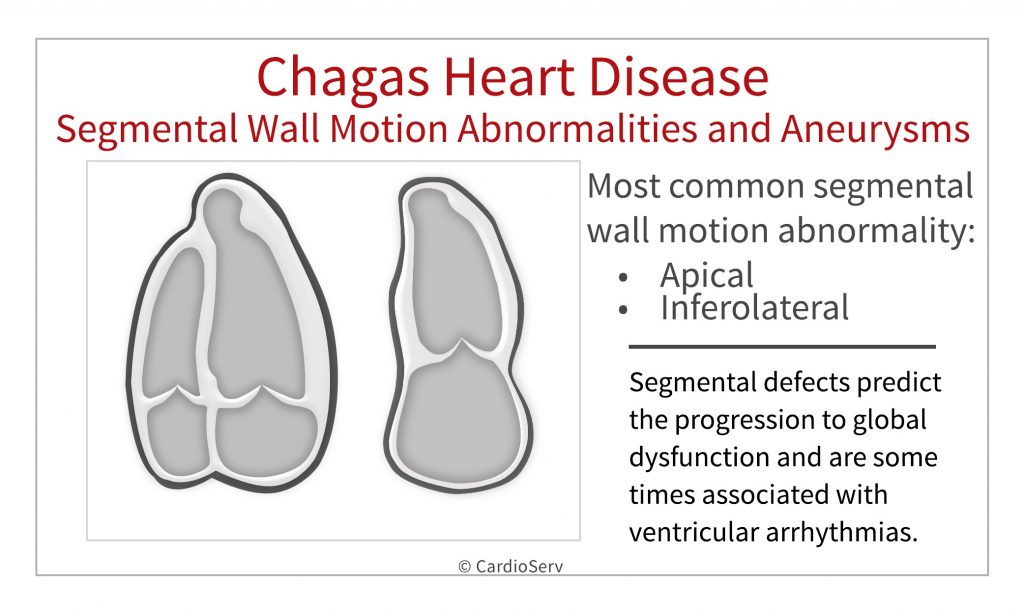
One of the earliest and most important clues is the presence of regional wall motion abnormalities that do not align with a single coronary artery distribution.
Instead of a classic ischemic pattern, you may see:
- Apical involvement
- Inferolateral wall abnormalities
- Patchy or discontinuous dysfunction
This mismatch between wall motion abnormalities and coronary anatomy should raise suspicion, especially in the right clinical context.
2. Apical Aneurysm Formation (Classic Finding)
Left ventricular apical aneurysm is a hallmark feature of Chagas cardiomyopathy.
These aneurysms may:
- Develop early, sometimes before significant global LV dysfunction
- Appear disproportionate to overall ventricular size
- Serve as a nidus for thrombus formation
Unlike post-infarct aneurysms, these are not tied to a clear ischemic event.
3. Progressive Transition to Dilated Cardiomyopathy
As the disease advances, patients often develop:
- Global hypokinesis
- Left ventricular dilation
- Secondary (functional) mitral and tricuspid regurgitation may develop as a result of ventricular dilation and annular remodeling, rather than primary valve disease.
At this stage, the distinction from other forms of non-ischemic cardiomyopathy becomes more difficult, making early recognition even more important.
4. Thrombus and Embolic Risk
Due to regional dysfunction and aneurysm formation, patients are at increased risk for intracardiac thrombus, particularly within the LV apex.
Careful evaluation of the apex is essential, especially when image quality is suboptimal.
Summary
Chagas cardiomyopathy is often silent until advanced stages, but the echo lab is frequently where the first clues appear.
Recognizing segmental abnormalities that do not follow coronary distributions, identifying early aneurysm formation, and correlating findings with conduction disease are key to raising suspicion.
In many cases, echocardiography is not just confirming disease, it is the first step toward diagnosis.
When the pattern doesn’t fit, it’s worth asking the question early, because timely recognition can change the trajectory of the disease.
Chagas Disease and Echocardiography FAQ
Chagas disease is most commonly transmitted by triatomine insects, sometimes called “kissing bugs.” It can also be spread congenitally during pregnancy or birth, through contaminated food, blood transfusion, organ transplantation, and, less commonly, laboratory exposure.
Cardiac involvement may include conduction disease such as right bundle branch block, regional wall motion abnormalities, apical aneurysm formation, ventricular dysfunction, thrombus, and progression to dilated cardiomyopathy.
Echocardiography can help identify findings such as segmental wall motion abnormalities that do not follow a typical coronary distribution, apical aneurysm, thrombus, ventricular dilation, global hypokinesis, and secondary mitral or tricuspid regurgitation.
Chagas disease is curable when antiparasitic treatment is given early in the acute phase. In chronic infection, treatment and follow-up may help prevent or slow progression and reduce transmission risk during pregnancy and birth.

Judith Buckland, MBA, RDCS, FASE
Stay Connected: Facebook, Twitter, Instagram, LinkedIn
References
American Heart Association. (2018, September). Chagas Cardiomyopathy: An Update of Current Clinical Knowledge and Management A Scientific Statement From the American Heart Association. Retrieved from https://www.ahajournals.org/doi/pdf/10.1161/CIR.0000000000000599
American Society of Echocardiography. (2018, January). Recommendations for Multimodality Cardiac Imaging in Patients with Chagas Disease: A Report from the American Society of Echocardiography in Collaboration With the InterAmerican Association of Echocardiography (ECOSIAC) and the Cardiovascular Imaging Department of the Brazilian Society of Cardiology (DIC-SBC). Retrieved from http://asecho.org/wordpress/wp-content/uploads/2018/01/2018_Chagas.pdf