Last Updated on June 23, 2026 by Judith Buckland, MBA, RDCS, FASE
Artificial intelligence has become one of the most discussed topics in cardiovascular imaging. Much of the conversation has focused on whether AI can automate measurements, improve efficiency, or assist with interpretation.
Those are important questions, but they may no longer be the most interesting ones.
Recently, I had the opportunity to participate as a co-author on a study published in JACC: Advances evaluating a deep learning model designed to automatically identify and segment cardiac anatomy during intracardiac echocardiography (ICE) procedures.
While the study demonstrated promising performance, what struck me most was not the accuracy metrics. It was what those results may signal about the future direction of cardiovascular imaging.
We may be entering a new phase of AI development—one that extends beyond automated measurements and begins to support real-time procedural guidance.
The First Wave: Automation
The earliest cardiovascular imaging AI tools focused primarily on automation.
Can AI measure ejection fraction?
Can AI calculate chamber volumes?
Can AI identify landmarks and reduce manual tracing?
These applications were valuable because they addressed one of the most time-consuming aspects of imaging workflow: measurement acquisition.
Yet even as these technologies improved, an important reality remained.
Measurements alone do not make diagnoses.
Anyone who has spent time reviewing cardiovascular imaging studies understands that obtaining a number and understanding what that number means are very different skills.
The Second Wave: Validation
As AI capabilities expanded, attention shifted toward validation.
The question was no longer simply whether AI could generate a measurement.
The question became whether those measurements were accurate, reproducible, and clinically reliable.
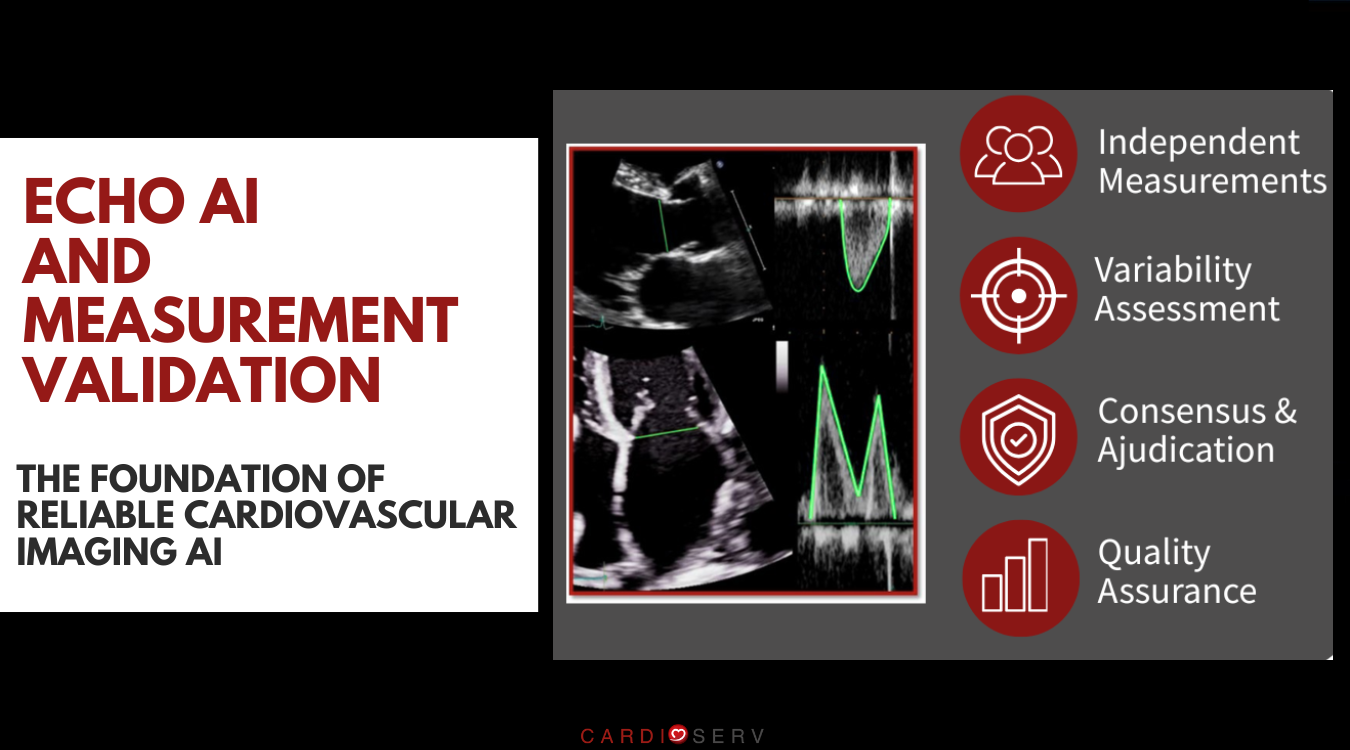
This is where quality programs, peer review, variability assessment, and expert oversight became critically important.
Healthcare organizations quickly realized that introducing AI did not eliminate the need for quality systems. In many cases, it increased their importance.
An inaccurate measurement performed quickly is still an inaccurate measurement.
Validation became the bridge between technological capability and clinical trust.
The Third Wave: Guidance
Today, we are beginning to see something different.
Rather than simply measuring anatomy, AI is starting to assist with understanding anatomy.
In our recently published study, a deep learning model was trained to identify and segment multiple cardiac structures during intracardiac echocardiography procedures. The goal was not merely to generate measurements but to help visualize anatomy in real time during invasive cardiac procedures.
This represents a meaningful shift.
The future of cardiovascular imaging may not be defined solely by automated calculations. It may increasingly involve systems that help clinicians navigate anatomy, recognize structures, identify procedural landmarks, and support decision-making during patient care.
The distinction is subtle but important.
Automation performs tasks.
Guidance supports clinical judgment.
Why This Matters
Cardiovascular imaging has always depended on expertise.
Experienced sonographers recognize patterns before measurements are obtained.
Experienced physicians often identify physiologic abnormalities before completing a formal interpretation.
This is because expert performance is rarely driven by isolated measurements. It is driven by pattern recognition.
The future applications of AI may increasingly support this process.
Imagine technologies that assist with:
- Real-time anatomical identification
- Procedural navigation
- Recognition of diagnostic patterns
- Detection of discordant findings
- Identification of image acquisition challenges
- Clinical decision support
These systems would not replace expertise.
They would operate alongside expertise.
The Quality Challenge Ahead
Ironically, as AI becomes more sophisticated, the importance of quality infrastructure may increase rather than decrease.
AI systems require:
- High-quality training data
- Expert annotation
- Ongoing validation
- Performance monitoring
- Governance frameworks
- Clinical oversight
Every AI model ultimately reflects the quality of the data and expertise used to build it.
Without strong quality systems, variability simply moves from human processes into technological processes.
This is why discussions about AI should not be limited to software performance alone.
Organizations must also ask:
- How will we validate these tools?
- How will we monitor performance over time?
- How will we identify errors?
- How will we ensure consistency across users and patient populations?
- How will we maintain diagnostic quality as technology evolves?
These are quality questions.
The Human Element Remains Essential
One misconception about AI is that better technology will reduce the need for expertise.
The opposite may be true.
As technology assumes more routine tasks, the value of human expertise becomes concentrated in higher-level functions:
- Clinical reasoning
- Pattern recognition
- Contextual interpretation
- Quality oversight
- Diagnostic coherence
The future imaging professional may spend less time performing repetitive measurements and more time evaluating whether the entire diagnostic story makes sense.
That shift has important implications for education, competency development, and quality improvement.
Looking Forward
The publication of this study represents one small step in a much larger transformation occurring across cardiovascular imaging.
Artificial intelligence will continue to evolve.
Automation will improve.
Guidance systems will become more sophisticated.
Workflows will change.
Yet one principle remains unchanged.
Technology is most valuable when it improves the consistency, quality, and reliability of patient care.
For those of us working in cardiovascular imaging quality, that remains the central objective.
The future of cardiovascular imaging will not be defined by artificial intelligence alone.
It will be defined by how effectively we combine technology, expertise, quality systems, and clinical judgment to improve outcomes for the patients we serve.
Related Resources
- Echo Measurement Validation in Cardiovascular AI
- Echo AI Validation in Action
- Cardiovascular Imaging Quality Improvement
- Accreditation Readiness Services

Judith Buckland, MBA, RDCS, FASE
Founder